
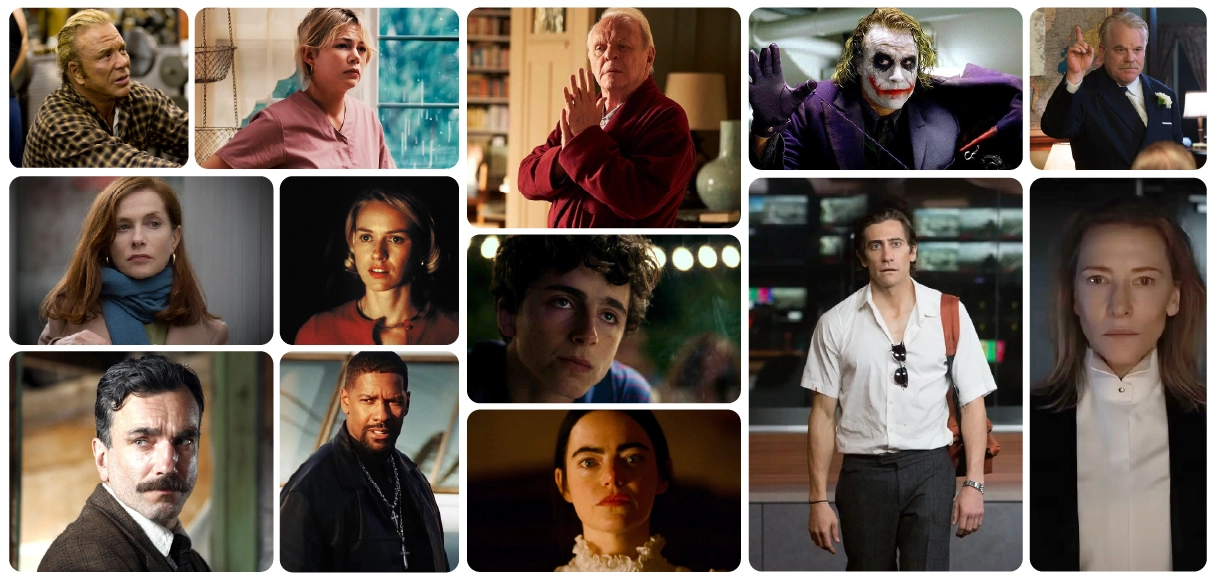

The greatest movie performances of the 21st century are not the same list as the greatest movies of the 21st century. Daniel Day-Lewis is not on the Best of the 21st Century film list because There Will Be Blood isn’t typically ranked in the top 25 of the era, but the performance sits at #1 on virtually every serious performances list ever compiled, including this one.
Heath Ledger’s Joker is not the reason The Dark Knight is ranked highly. It’s the other way around. The 25 performances below are the acting achievements that define the era, chosen against five specific criteria (Transformation, Sustained Command, The Signature Moment, Genre Elevation, and Cultural Durability), one performance per actor, ranked with a scorecard the reader can audit.
The Five Marks of a Great Performance is the framework this article runs on. The one-per-actor rule, which follows The Ringer’s August 2025 methodology, prioritizes breadth over concentration, so no one’s favorite actor gets to hog three slots. Section 5 handles actors with multiple would-rank performances. Section 6 covers honorable mentions across the three decades. Section 7 covers category standouts: foreign language, breakouts, and voice work.
What Counts as a “Great Performance” in the First Place
“Great performance” is not the same as “Oscar-winning performance” or “critically praised performance” or “audience-favorite performance.” Any of those things can be true without a performance being great, and greatness can be true without any of those things. The framework in Section 3 defines what does count. This section explains why the definition matters.
Why Oscars aren’t the measure. The Oscar for Best Actor has gone to 25 different actors in the 21st century, but not every winner appears in the Top 25 in this article, and some of the era’s most-cited performances won no Oscar at all. Naomi Watts wasn’t even nominated for Mulholland Drive (2001).
Joaquin Phoenix’s Freddie Quell (2012) lost to Daniel Day-Lewis. Isabelle Huppert’s Michèle Leblanc in Elle (2016) lost too. Meanwhile, the Oscars have gone to some performances that haven’t aged into anything close to historic status; the acting categories carry their own political and industrial pressures every single year. Oscars are one data point in the framework’s Cultural Durability mark, but they were never meant to be the mark itself.
Why critical acclaim isn’t enough. Critical acclaim in the moment isn’t enough either, because contemporary reviews reflect the moment more than the eventual achievement. Performances praised hard in their release window often fade once the industry’s frame shifts onto something newer. The framework’s fifth mark, Cultural Durability, exists specifically to filter for the performances that keep getting cited five, ten, twenty years after the film left theaters. A performance that was praised in 2003 but hasn’t been mentioned since does not clear that mark. A performance that was under-praised in 2003, like Naomi Watts’s, but has since become foundational to the retrospective conversation, clears it easily.
Why the “great performance” claim is worth making at all. Why bother making a “great performance” claim at all? Because the 21st century has produced more film acting than any comparable period in cinema history. The industry has professionalized, training pipelines have strengthened, and the technology behind performance capture allows for more nuance than ever. The result is a body of work so deep that the top 25 isn’t obvious, and any framework applied to it has to be transparent enough that reasonable people can disagree without dismissing the whole exercise as arbitrary. The Five Marks below are this article’s answer to that requirement.
The Five Marks of a Great Performance
Every performance in the Top 25 passes at least four of five criteria. The framework below names them. A performance that hits all five sits at the top of the list. A performance that hits four lands somewhere in the top 25. A performance that hits three or fewer belongs in the honorable mentions in Section 6.
Mark 1: Transformation
Transformation measures how far the actor travels from themselves. Physical transformation (Marion Cotillard’s Edith Piaf, Daniel Day-Lewis’s Lincoln, Zac Efron’s Kevin Von Erich) is one form of it. Character transformation (Cate Blanchett’s Lydia Tár, Naomi Watts’s Betty and Diane, Cillian Murphy’s Oppenheimer) is another. This mark isn’t really about prosthetics or accents in themselves. It’s about the actor becoming someone the audience couldn’t otherwise mistake them for. An actor playing a version of their own public persona, whether charming, roguish, or brooding, doesn’t clear this mark unless that version specifically serves the film.
Mark 2: Sustained Command
Sustained Command measures whether the actor holds their scenes across the full runtime. Lead performances, like Freddie Quell, Daniel Plainview, or Betty Elms, have to carry the whole film. Supporting performances, like the Joker, Chigurh, or J.K. Simmons in Whiplash, have to make every appearance structurally essential even with far less screen time. This is the difference between a great scene and a great performance. A memorable ten minutes inside a two-hour film doesn’t qualify on its own. The performance has to earn its time on screen from beginning to end.
Mark 3: The Signature Moment
The Signature Moment asks whether the performance produced a scene that has entered the culture as shorthand for the performance itself. Plainview drinks the milkshake. The Joker performs the pencil trick. Randy the Ram wrestles his final match. Nearly every top performance on this list has one of these moments. Great performances that lack one, usually because the film is too even in tone or the character too quiet, tend to sit lower in the ranking. This is the mark that separates great performances from great performances people actually quote at parties.
Mark 4: Genre Elevation
Genre Elevation asks whether the performance changed what its genre thought it could do. Heath Ledger elevated what a comic-book villain could be. Anthony Hopkins in The Father elevated what an intimate psychological drama could deliver. Michelle Yeoh in Everything Everywhere All at Once elevated what a multiverse comedy could carry emotionally. Not every top performance clears this mark, since some of the strongest work happens in genres already operating at their peak, but the performances that do clear it tend to rank higher because they expand what the industry believes is possible.
Mark 5: Cultural Durability
Cultural Durability is the retrospective mark, the one that asks whether a performance stays in the culture years after release. The Joker (2008), Alonzo Harris (2001), Daniel Plainview (2007), and Freddie Quell (2012) are all still being discussed in 2026. This mark can only be scored on performances at least five years old. Recent performances get a “Provisional” tag and are ranked on the other four marks, with Cultural Durability assumed rather than confirmed. It’s the mark that separates the truly great from the merely well-reviewed.
A performance is scored from 0 to 5 depending on how many marks it hits. Top 10 performances on this list typically hit all five. Ranks 11 through 25 typically hit four of five. Anything that clears three or fewer sits in the honorable mentions instead. The rule isn’t purely mechanical; editorial judgment applies to close calls. But the framework gives the ranking a structure readers can actually push back against, which is the whole point.
The 25 Greatest Movie Performances of the 21st Century, Ranked.
The ranking below counts down from #25 to #1. Each performance is scored against the Five Marks with a scorecard attached. The order reflects editorial judgment supported by that framework, so a reader who disagrees with a placement can see exactly which marks are being weighted and recalculate their own version. Performances are limited to one per actor; Section 5 covers actors who had a second or third performance that would have ranked under a looser rule.
#25. Michelle Williams as Cindy Heller, Blue Valentine (2010) — Score: 4/5
Director: Derek Cianfrance
Genre: Romantic drama
Recognition: Oscar nomination, Best Actress.
Scorecard: Transformation, yes (Williams disappears into working-class Pennsylvania). Sustained Command, yes (the dual timeline effectively asks her to play two performances at once). Signature Moment, no (the film is too diffuse to isolate a single scene). Genre Elevation, yes (it raised the ceiling on what indie romance could attempt). Cultural Durability, yes (still cited fifteen years on).
The role: Cindy is a nurse whose disintegrating marriage to Dean, played by Ryan Gosling, unfolds across two intercut timelines: the early romance and the late collapse.
Why it’s ranked here: Williams essentially delivers two performances in one film: the young Cindy discovering Dean and the older Cindy discovering she can’t stay, and the two versions have to inform each other without ever directly overlapping. She holds both timelines steady without either one leaning on the other for support.
The signature moment: The signature scene, if there is one, is the abortion clinic sequence in the film’s second act, where Williams carries the emotional weight of the whole picture in near silence.
The Screendollars Take: Blue Valentine is not a film about a marriage ending. It is a film about a woman discovering that the thing which once rescued her has become the thing she has to survive. Williams plays two Cindys who never share a frame: the younger one leans into Dean, the older one has learned to angle herself away, and almost nothing changes except the shoulders and the speed of the eyes. In the clinic sequence, she carries the entire argument of the picture without dialogue. The romance is not the flashback. The romance is what she has to stop believing.
Streaming US: Streaming on Prime Video (including Prime Video with Ads). Free with ads on Tubi, Pluto TV. Free with a library card on Kanopy, Hoopla. Rent/buy on Amazon Video, Apple TV, Fandango at Home.
#24. Jake Gyllenhaal as Louis Bloom, Nightcrawler (2014) — Score: 4/5
Director: Dan Gilroy
Genre: LA noir, psychological thriller
Recognition: Golden Globe nomination.
Scorecard: Transformation, yes (Gyllenhaal dropped roughly 20 pounds; the eyes alone are unrecognizable). Sustained Command, yes (he carries the film start to finish). Signature Moment, yes (the restaurant scene with Rene Russo). Genre Elevation, yes (he redefined the American antihero for the decade). Cultural Durability, yes (still the reference point for the sociopath performance of the 2010s).
The role: Louis Bloom is a Los Angeles drifter who starts filming crime scenes for local news and escalates his methods as his career takes off.
Why it’s ranked here: Gyllenhaal built the character outside i:, the weight loss, the eyes, the flattened voice, then filled that shell with a genuine sociopath’s internal logic. This isn’t a performance of evil so much as a performance of someone who has learned ambition’s vocabulary without any of the humanity that usually comes attached to it. That distinction is what makes Bloom so unsettling.
The signature moment: The signature moment is the restaurant scene with Rene Russo, where Bloom’s ethics become explicit, and Russo has to keep her face perfectly still while everything underneath it breaks.
The Screendollars Take: Louis Bloom is not a sociopath who found a job. He is a job that found a body. Gyllenhaal builds him from the outside in: twenty pounds gone, eyes too large for the face, a voice pitched at the register of a man reciting a management seminar he only half understood. The restaurant scene with Rene Russo is a negotiation staged as a courtship, and he never once blinks.
Streaming US: Streaming on AMC+, Sundance Now, Philo, fuboTV, Shout! Factory Amazon Channel. Free with ads on The Roku Channel, Shout! Factory TV. Free on Kanopy. Rent/buy on Amazon Video, Apple TV, Fandango at Home.
#23. Emma Stone as Bella Baxter, Poor Things (2023) — Score: 4/5, Provisional
Director: Yorgos Lanthimos
Genre: Fantasy comedy-drama
Recognition: Oscar, BAFTA, and Golden Globe winner, Best Actress.
Scorecard: Transformation, yes (Stone plays a woman with the brain of an infant maturing in real time across the runtime). Sustained Command, yes (every scene). Signature Moment, yes (the Lisbon dance sequence). Genre Elevation, yes (it raised what a Lanthimos film could ask of its lead). Cultural Durability, provisional; 2023 needs more time to settle.
The role: Bella Baxter is a Victorian woman surgically reanimated with the brain of an infant, whose consciousness matures as the film progresses.
Why it’s ranked here: Stone plays a woman becoming a person in real time, infantile at the start, adolescent by the middle stretch, adult by the end, and she has to make that progression legible without the film ever handing her a milestone to lean on. The physical comedy alone would be a feat. The emotional undertow running beneath it is what actually makes the performance great.
The signature moment: The signature moment is the dance that turns into a scene of liberation in Lisbon, Stone’s body doing something few other actors working today could pull off.
The Screendollars Take: Bella Baxter is not a woman with an infant’s brain. She is a person assembling a self in public with no shame installed. Stone runs the progression through the body first: the wide gait, the grabbing hands, then the slow arrival of hesitation as thought catches up with impulse. The Lisbon dance works precisely because it is not graceful; it is appetite with a rhythm section. Bella never becomes civilised.
Streaming US: Streaming on Netflix (including Netflix Standard with Ads). Rent/buy on Amazon Video, Apple TV, Fandango at Home, Spectrum On Demand.
#22. Chiwetel Ejiofor as Solomon Northup, 12 Years a Slave (2013) — Score: 4/5
Director: Steve McQueen
Genre: Historical drama
Recognition: BAFTA winner, Oscar nomination.
Scorecard: Transformation, yes. Sustained Command, yes. Signature Moment, yes (the hanging scene). Genre Elevation, yes (it redefined what historical American slavery cinema could attempt). Cultural Durability, yes.
The role: Solomon Northup is a free Black musician kidnapped into slavery in 1841, forced to survive twelve years on Louisiana plantations before he’s finally restored to freedom.
Why it’s ranked here: Ejiofor carries the film’s central moral weight without ever leaning on rhetoric to do it for him. He plays Solomon’s resilience as something private, held internally rather than performed for the camera, and the tension between what Solomon has to show his captors and what he actually is becomes the performance’s structural engine. Steve McQueen’s direction gives him the long, unbroken takes needed to hold that interior life on screen.
The signature moment: The signature moment is the hanging scene, Ejiofor suspended for minutes of screen time while life continues around him and he says nothing at all.
The Screendollars Take: Solomon Northup is not a man enduring slavery. He is a man performing a diminished version of himself for twelve years to stay alive. Ejiofor keeps two levels running at once: the deference he shows the men who own him, and the intelligence he cannot afford to let them see. McQueen’s long takes give that split nowhere to hide, and in the hanging scene Ejiofor barely acts at all, toes in mud, the plantation carrying on behind him. Freedom does not restore him at the end. It only stops the performance.
Streaming US: Streaming on Hulu. Rent/buy on Amazon Video, Apple TV, Fandango at Home, Spectrum On Demand.
#21. Mickey Rourke as Randy “The Ram” Robinson, The Wrestler (2008) — Score: 4/5
Director: Darren Aronofsky
Genre: Character drama
Recognition: Golden Globe and BAFTA winner, Oscar nomination.
Scorecard: Transformation, yes (Rourke’s own body carries the character). Sustained Command, yes. Signature Moment, yes (the final match). Genre Elevation, yes (it redefined what an American character drama could look like). Cultural Durability, yes.
The role: Randy “The Ram” Robinson is an aging professional wrestler whose body is failing and whose life outside the ring never recovered from his peak years.
Why it’s ranked here: The Wrestler is the rare film where the actor’s own history is inseparable from the character’s: Rourke had spent a decade in the boxing wilderness before this role found him. The performance reads less like a portrayal and more like documentation. His body, his voice, his affect all belong to Randy without a shred of pretense, and the film simply could not have been made with anyone else in the part.
The signature moment: The signature moment is the final match sequence, Randy climbing the ropes for the finishing move as the film cuts to black before we ever see him land.
The Screendollars Take: The Wrestler is not a comeback story. It is a document of a body that has already paid. Rourke does not build Randy so much as lend him: the hearing aid, the reading glasses, the apology delivered through the shoulders. The deli counter scenes carry the real risk, an entertainer attempting to be ordinary and failing at it in front of strangers. The ring is the only room where he is not lying.
Streaming US: No current subscription streaming. Rent/buy on Amazon Video, Apple TV, Fandango at Home.
#20. Adam Driver as Charlie Barber, Marriage Story (2019) — Score: 4/5
Director: Noah Baumbach
Genre: Divorce drama
Recognition: Oscar, BAFTA, and SAG nominations.
Scorecard: Transformation, yes (Driver’s usual charm gets inverted here). Sustained Command, yes. Signature Moment, yes (the apartment argument). Genre Elevation, yes (it raised the divorce-drama register). Cultural Durability, yes.
The role: Charlie Barber is a New York theater director whose marriage to Nicole, played by Scarlett Johansson, is ending.
Why it’s ranked here: The film tracks the divorce from both sides, and Driver anchors his half. The performance is built for close attention: Charlie thinks of himself as decent while behaving in ways that are decent-adjacent at best, and the gap between his self-image and his actual conduct is the whole mechanism. Driver plays both sides of that gap at once without ever tipping the audience against him.
The signature moment: The signature moment is the apartment argument with Johansson, one of the most-discussed acted arguments of the 2010s and arguably the decade’s most quoted scene of a marriage coming apart in real time.
The Screendollars Take: Charlie Barber is not the villain of this divorce, and that is the trap Driver sets. He plays a man whose decency is real and roughly twenty percent smaller than he believes it to be. Watch how Charlie listens: with enormous attention and no curiosity. The apartment argument detonates because he keeps trying to return to reason, and reason keeps turning into another weapon. He never lies to Nicole.
Streaming US: Streaming on Netflix. No rental or purchase options currently listed.
#19. Timothée Chalamet as Elio Perlman, Call Me by Your Name (2017) — Score: 4/5
Director: Luca Guadagnino
Genre: Romantic drama
Recognition: Oscar and BAFTA nominations, Best Actor.
Scorecard: Transformation, yes (Chalamet plays 17 with real precision, at 20). Sustained Command, yes. Signature Moment, yes (the closing fireplace shot). Genre Elevation, yes (it elevated the coming-of-age register). Cultural Durability, yes.
The role: Elio Perlman is a 17-year-old spending the summer of 1983 at his family’s villa in northern Italy when Oliver, a graduate student played by Armie Hammer, arrives.
Why it’s ranked here: Chalamet plays adolescent longing without ever ironizing it. The role requires him to hold physical restlessness, intellectual precocity, and emotional confusion all at once, which is to say the specific texture of being seventeen. That precision, paired with the film’s final unbroken close-up, produced one of the era’s most-cited breakout performances.
The signature moment: The signature moment is that final closeup by the fireplace, one emotion held across the entire length of the closing credits.
The Screendollars Take: Elio is not a boy in love. He is a boy learning that wanting something is a physical condition. Chalamet plays seventeen as a coordination problem: too much intellect, too little control of the skin, a body that keeps announcing what the mouth denies. Guadagnino’s closing unbroken close-up hands him nothing to do but hold, and he holds. The credits run over a face working out what this will cost.
Streaming US: No current subscription streaming. Rent/buy on Amazon Video, Apple TV, Fandango at Home, FlixFling.
#18. Michelle Yeoh as Evelyn Wang, Everything Everywhere All at Once (2022) — Score: 4/5
Directors: Daniel Kwan and Daniel Scheinert
Genre: Multiverse sci-fi comedy-drama
Recognition: Oscar, BAFTA, Golden Globe, and SAG winner, Best Actress; BAFTA nomination.
Scorecard: Transformation, yes (Yeoh plays several versions of Evelyn across the multiverse). Sustained Command, yes. Signature Moment, yes (the rocks scene). Genre Elevation, yes (it elevated multiverse cinema entirely). Cultural Durability, yes, and already dominant in the conversation.
The role: Evelyn Wang is a laundromat owner whose failing business and fractured family life get interrupted when she discovers she’s the multiverse’s chosen defender.
Why it’s ranked here: Yeoh’s performance isn’t really one performance; it’s dozens of Evelyns, each requiring its own distinct calibration, all anchored to a single emotional throughline about a mother’s love for her daughter. The technical demand alone would be remarkable. The emotional coherence she manages to hold across that technical demand is what actually makes it great.
The signature moment: The signature moment is the rocks scene in the “everything bagel” universe, two black slabs sitting on screen while Yeoh’s voice carries the film’s entire love story on its own.
The Screendollars Take: Evelyn Wang is not a chosen one. She is a woman who has spent her life being told she chose wrong. The technical feat is the dozen Evelyns; the actual achievement is that the laundromat Evelyn stays visible underneath every one of them, tired, impatient, unconvinced. The rocks scene removes her face from the film entirely, and the performance survives it.
Streaming US: Free with ads on Plex (added July 2026). Rent/buy on Amazon Video, Apple TV, Fandango at Home, Spectrum On Demand. Also in limited theatrical re-release. See conflict log.
#17. Daniel Kaluuya as Chris Washington, Get Out (2017) — Score: 4/5
Director: Jordan Peele
Genre: Horror, social thriller
Recognition: Oscar nomination, Best Actor.
Scorecard: Transformation, yes. Sustained Command, yes. Signature Moment, yes (the sunken place tear). Genre Elevation, yes (it redefined the horror-lead register). Cultural Durability, yes.
The role: Chris Washington is a Black photographer whose visit to his white girlfriend’s family estate turns increasingly wrong.
Why it’s ranked here: Kaluuya plays a horror protagonist with the interior work of a prestige drama. The performance is built around everything Chris knows he can’t say out loud: the calculations, the code-switching, the private fear running underneath a calm surface. The famous single tear in the sunken place made Kaluuya’s approach go viral, but the performance’s real work is the sustained restraint that makes that tear land the way it does.
The signature moment: The signature moment is the sunken place sequence itself, the tear falling as Kaluuya sits paralyzed, watching a screen of himself he can’t reach.
The Screendollars Take: Chris Washington is not a horror protagonist who happens to be Black. He is a man whose survival instincts are the same ones he uses at parties. Kaluuya plays the first act entirely in the register of politeness under pressure: the small laugh, the deferred question, the decision not to name what he just saw. The most frightening thing in that house is how long he is willing to stay polite.
Streaming US: Streaming on YouTube TV. Rent/buy on Amazon Video, Apple TV, Fandango at Home.
#16. Cillian Murphy as J. Robert Oppenheimer, Oppenheimer (2023) — Score: 4/5, Provisional
Director: Christopher Nolan
Genre: Historical drama
Recognition: Oscar, BAFTA, Golden Globe, and SAG winner, Best Actor.
Scorecard: Transformation, yes. Sustained Command, yes. Signature Moment, yes (the Trinity test). Genre Elevation, yes (it elevated the historical biopic at Nolan’s scale). Cultural Durability, provisional.
The role: J. Robert Oppenheimer is the theoretical physicist who led the Manhattan Project, tracked here from Princeton in the 1930s through the Trinity test in 1945 to the security hearing that destroyed his reputation in 1954.
Why it’s ranked here: Murphy plays a man aware he’s shaping history from the inside as it happens. The role asks him to hold intellectual precision, political naivety, personal fragility, and moral horror all at once, sometimes within the same scene. Nolan’s direction gives him the closeups; Murphy is the one who has to carry them.
The signature moment: The signature moment is the Trinity test itself, Murphy’s face lit by the flash and holding a single unreadable emotion for the full length of the sequence.
The Screendollars Take: Oppenheimer is a genius biopic. It is a study of a man watching his own myth assemble around him and deciding not to interrupt it. Murphy plays vanity and horror as a single expression, which is why the Trinity closeups hold for as long as Nolan needs them to. He built the thing. Then he spent the rest of his life being asked to explain it.
Streaming US: No current subscription streaming. Rent/buy on Amazon Video, Apple TV, Fandango at Home, Spectrum On Demand. See conflict log.
#15. Isabelle Huppert as Michèle Leblanc, Elle (2016) — Score: 4/5
Director: Paul Verhoeven
Genre: Psychological thriller
Recognition: Golden Globe winner, Best Actress Drama; Oscar nomination.
Scorecard: Transformation, yes (Huppert operates in a register few actors would even attempt). Sustained Command, yes. Signature Moment, yes (the second-act dinner-party reveal). Genre Elevation, yes (it redefined what a rape-revenge drama could ethically attempt). Cultural Durability, yes.
The role: Michèle Leblanc is a Parisian video-game company CEO who is raped in her own home.
Why it’s ranked here: The film tracks her response, which follows none of the paths the genre usually expects. Elle could only have been made with an actress willing to hold a very specific tonal register, and Huppert plays Michèle without any moral cushioning. She isn’t made sympathetic, isn’t made monstrous, isn’t made into an example of anything. The performance’s refusal to serve any of the film’s potential moral readings is exactly what makes it structurally radical.
The signature moment: The signature moment arrives at the second-act dinner party, Huppert playing the scene at precisely the same temperature she played the previous ninety minutes.
The Screendollars Take: Elle is not just a revenge film. It is a film where Huppert plays Michèle at one temperature throughout, across the assault, the business meeting, the affair, the dinner party. It shows a woman who decided long ago that reaction is a currency she will not spend in public. The film never explains her. That refusal is the performance.
Streaming US: Free with ads on Tubi. Rent/buy on Amazon Video, Apple TV, Google Play.
#14. Frances McDormand as Mildred Hayes, Three Billboards Outside Ebbing, Missouri (2017) — Score: 4/5
Director: Martin McDonagh
Genre: Dark comedy-drama
Recognition: Oscar, BAFTA, Golden Globe, and SAG winner, Best Actress.
Scorecard: Transformation, yes. Sustained Command, yes. Signature Moment, yes (the priest confrontation). Genre Elevation, yes (it redefined the grieving-mother register). Cultural Durability, yes.
The role: Mildred Hayes is a mother whose daughter’s murder remains unsolved.
Why it’s ranked here: She rents three highway billboards to force the local police into action. McDormand plays a woman who refuses to perform grief the way films usually ask their grieving mothers to. Mildred isn’t softened, isn’t made lovable, isn’t made palatable, and McDormand plays that refusal without ever asking the audience to like her for it. It’s one of the most-cited examples of the 2010s tradition of women characters who don’t need to be redeemed to be understood.
The signature moment: The signature moment is the priest confrontation, McDormand delivering a monologue about the Catholic Church without once raising her voice.
The Screendollars Take: Mildred Hayes is a woman who has converted grief into a job and shows up to it every morning. McDormand moves through the film in coveralls and a bandana like someone with tasks to complete, which is why the anger never reads as hysteria. The priest confrontation is delivered at conversational volume, and that is what turns it from a speech into a demolition. She does not want justice, and she does not want closure.
Streaming US: Streaming on HBO Max (also via HBO Max Amazon Channel, YouTube TV). Rent/buy on Amazon Video, Apple TV, Fandango at Home, Spectrum On Demand.
#13. Adrien Brody as Wladyslaw Szpilman, The Pianist (2002) — Score: 4/5
Director: Roman Polanski
Genre: WWII drama
Recognition: Oscar and César winner, Best Actor (the youngest Best Actor winner at the time).
Scorecard: Transformation, yes (Brody lost around 30 pounds for the role). Sustained Command, yes. Signature Moment, yes (the piano performance for the German officer). Genre Elevation, yes (it elevated Holocaust cinema’s use of a single-character point of view). Cultural Durability, yes.
The role: Wladyslaw Szpilman is the Polish-Jewish pianist who survived the Warsaw Ghetto and the Holocaust by hiding across a series of Warsaw safe houses.
Why it’s ranked here: Brody plays the arc of a person being progressively erased. As the character’s physical existence contracts, from concert pianist to ghetto laborer to hidden survivor to something close to a skeleton, Brody has to keep the interior life from contracting along with it. The final piano performance for Captain Wilm Hosenfeld is the film’s structural hinge, and Brody plays it like a man remembering, almost against his will, that he’s still a person.
The signature moment: The signature moment is that performance of Chopin’s Ballade No. 1, delivered as though the character has genuinely forgotten how it feels to be moved by anything.
The Screendollars Take: The Pianist is not a film about survival. It is a film about a man being reduced, item by item, to the one thing that cannot be confiscated. Brody plays the contraction physically, thirty pounds gone, but the real work is in the hands, which keep finding keyboards that are not there. By the Hosenfeld scene,e he plays like a man testing whether the ability still belongs to him. Chopin does not save him. It reminds him that he used to be a person.
Streaming US: Streaming on Prime Video (including with ads), YouTube TV, CuriosityStream (Amazon and Apple TV channels). Free with ads on Tubi, The Roku Channel, Fandango at Home Free. Free on Fawesome. Rent/buy on Amazon Video, Apple TV, Fandango at Home.
#12. Anthony Hopkins as Anthony, The Father (2020) — Score: 4/5
Director: Florian Zeller
Genre: Psychological drama
Recognition: Oscar winner, Best Actor (the oldest Best Actor winner at the time); BAFTA winner.
Scorecard: Transformation, yes. Sustained Command, yes. Signature Moment, yes (the closing scene). Genre Elevation, yes (it redefined what a dementia film could achieve). Cultural Durability, yes.
The role: Anthony is an 80-year-old man in London living with dementia.
Why it’s ranked here: The film is built so the audience experiences his confusion directly: timelines shift, characters change actors mid-scene, spaces reconfigure without warning. Hopkins plays a man whose mind is dissolving without ever acting out the dissolution itself. He has to be fully present in each scene as though the previous one never happened, because for Anthony, it didn’t. The closing scene, where he asks for his mother inside a nursing home, is one of the most-discussed final scenes of the 2020s so far.
The signature moment: The signature moment is that closing line, Hopkins reducing an elderly man to a child’s grief in a handful of words.
The Screendollars Take: The Father is a film shot from inside someone’s head, and Hopkins is the only person on screen who cannot know that. He plays every scene as a first scene: the charm, the suspicion, the flirtation with the carer, all deployed fresh, because for Anthony nothing has accumulated. Zeller swaps the furniture and swaps the actors; Hopkins changes nothing, and that steadiness is the horror. The closing line is not a twist. It is the floor.
Streaming US: Streaming on Sony Pictures Core Amazon Channel. Rent/buy on Amazon Video, Apple TV, Fandango at Home, Spectrum On Demand.
#11. Kirsten Dunst as Justine, Melancholia (2011) — Score: 4/5
Director: Lars von Trier
Genre: Sci-fi psychological drama
Recognition: Cannes winner, Best Actress.
Scorecard: Transformation, yes. Sustained Command, yes. Signature Moment, yes (the wedding-night breakdown). Genre Elevation, yes (it redefined how depression could be depicted on screen). Cultural Durability, yes.
The role: Justine is a bride whose severe depression makes her own wedding night unmanageable, the film’s entire first half.
Why it’s ranked here: In the second half, a rogue planet called Melancholia is on a collision course with Earth, and Justine turns out to be the only character who can accept what’s coming. Dunst plays depression as a way of seeing the world rather than a symptom of anything, one that turns out to be more accurate than everybody else’s. Her clarity in that second half, when the world is actually ending and she’s the only one not surprised, is the performance’s greatest achievement.
The signature moment: The signature moment is the wedding-night breakdown in the ballroom, Dunst’s face registering nothing while the celebration carries on around her.
The Screendollars Take: Justine is not broken in the first half and lucid in the second. She is the same woman throughout; the world simply catches up with her. Dunst plays the wedding as a failed obligation, smiling on a delay, eating meatloaf that tastes of ash, apologising to people whose reasoning she cannot follow. When the planet arrives, she stops performing altogether, and the flatness suddenly reads as competence. Melancholia does not change her. It agrees with her.
Streaming US: Streaming on fuboTV, YouTube TV, Criterion Channel, Magnolia Selects Amazon Channel. Free with ads on Tubi, Pluto TV, The Roku Channel, Plex. Free on Kanopy. Rent/buy on Amazon Video, Apple TV, Fandango at Home, FlixFling.
#10. Jesse Eisenberg as Mark Zuckerberg, The Social Network (2010) — Score: 4/5
Director: David Fincher
Genre: Biographical drama
Recognition: Oscar and Golden Globe nominations, Best Actor.
Scorecard: Transformation, yes (Eisenberg calibrates a very specific register here). Sustained Command, yes. Signature Moment, yes (the deposition scenes). Genre Elevation, yes (it redefined the tech-founder biopic). Cultural Durability, yes.
The role: Mark Zuckerberg is tracked here from his Harvard sophomore year through the founding of Facebook to the depositions that would define the company’s early legal history.
Why it’s ranked here: Eisenberg’s Zuckerberg is a precise engineering feat in itself: Aaron Sorkin’s rapid-fire dialogue delivered with the timing of someone convinced he’s the smartest person in every room, and the performance never once softens that arrogance for likability’s sake. The film’s whole argument depends on Eisenberg carrying Zuckerberg’s isolation as tragic without asking anyone to forgive him for it.
The signature moment: The signature moment is the deposition sequence, Eisenberg holding contempt across dialogue that still has to land precise comic rhythms.
The Screendollars Take: Eisenberg is playing a man who has calculated that being liked is a slower route than being necessary. The Sorkin cadence arrives without a single beat surrendered for charm; watch him land a joke and then decline the laugh it earned. In the depositions he sits slightly too still, a person being processed by institutions he has already outgrown.
Streaming US: No current subscription streaming. Rent/buy on Amazon Video, Apple TV, Fandango at Home, Spectrum On Demand. See conflict log.
#9. Marion Cotillard as Edith Piaf, La Vie en Rose (2007) — Score: 5/5
Director: Olivier Dahan
Genre: Biographical musical
Recognition: Oscar, BAFTA, César, and Golden Globe winner, Best Actress.
Scorecard: Transformation, yes (Cotillard’s physical embodiment of Piaf is total). Sustained Command, yes, across Piaf’s entire life. Signature Moment, yes (“Non, je ne regrette rien”). Genre Elevation, yes. Cultural Durability, yes.
The role: Edith Piaf is the French singer tracked here from childhood poverty in Belleville to global stardom to her death at 47. Cotillard’s Piaf is the 21st century’s most complete biographical transformation.
Why it’s ranked here: The physical work, the posture, the movement, the aging across decades, is total, and the vocal work matches Piaf’s actual recordings without tipping into impersonation. The win made Cotillard the first actress to take Best Actress for a French-language performance. Nearly two decades later, it’s still the reference point for what biographical transformation cinema can do.
The signature moment: The signature moment is the staging of “Non, je ne regrette rien,” an older, ailing Cotillard-as-Piaf singing the song that would come to define her legacy.
The Screendollars Take: Cotillard is not impersonating Édith Piaf. She is playing a woman who was never permitted offstage. The physical arc runs from a scavenging teenager to a bent forty-seven-year-old, and Cotillard alters the spine well before the makeup does any work. She performs to Piaf’s own recordings and still contrives to look like the source of the sound rather than its host. The voice was real. What Cotillard supplies is the cost of it.
Streaming US: No current subscription streaming. Rent/buy on Amazon Video, Apple TV, Fandango at Home.
#8. Denzel Washington as Detective Alonzo Harris, Training Day (2001) — Score: 5/5
Director: Antoine Fuqua
Genre: Crime drama
Recognition: Oscar winner, Best Actor.
Scorecard: Transformation, yes (Washington playing full-throttle villainy, inverted from his usual heroic register). Sustained Command, yes. Signature Moment, yes (“King Kong ain’t got nothin’ on me”). Genre Elevation, yes (it redefined the corrupt-cop archetype). Cultural Durability, yes.
The role: Alonzo Harris is a Los Angeles narcotics detective who spends 24 hours indoctrinating rookie Jake Hoyt, played by Ethan Hawke, into the ethics of the street, which turn out to be Alonzo’s ethics and nobody else’s.
Why it’s ranked here: Washington had never played villainy at this register before. The performance is calibrated for maximum charisma: Alonzo is persuasive, commanding, genuinely funny, which is exactly what makes his corruption so hard to sit with. The Oscar was the industry finally recognizing that Washington could disappear into a role he’d simply never been asked to play before.
The signature moment: The signature moment is the rooftop confrontation, the “King Kong ain’t got nothin’ on me” line landing as both a threat and a eulogy.
The Screendollars Take: Alonzo Harris is not a corrupt cop. He is a salesman, and Washington plays him at maximum charm for ninety minutes, and the charm is the crime: every laugh Jake gives him functions as a signature on a document. By the rooftop,p the pitch has failed, and what is left underneath is a man performing for an audience that has already gone home. “King Kong ain’t got nothin’ on me” is not a boast. It is the last pitch he has.
Streaming US: Streaming on Starz (via Starz Apple TV Channel, Starz Amazon Channel). Free with ads on Tubi. Rent/buy on Amazon Video, Apple TV, Fandango at Home, Spectrum On Demand.
#7. Joaquin Phoenix as Freddie Quell, The Master (2012) — Score: 5/5
Director: Paul Thomas Anderson
Genre: Psychological drama
Recognition: Venice Volpi Cup winner, Best Actor, shared with Philip Seymour Hoffman; Oscar nomination.
Scorecard: Transformation, yes (Phoenix’s physical distortion is total). Sustained Command, yes. Signature Moment, yes (the processing scene). Genre Elevation, yes. Cultural Durability, yes, and increasingly cited as one of the greatest performances of the century.
The role: Freddie Quell is a WWII veteran dealing with alcoholism, PTSD, and violent sexual dysfunction who falls into the orbit of Lancaster Dodd, played by Philip Seymour Hoffman, the founder of a nascent religious movement.
Why it’s ranked here: Phoenix’s Freddie isn’t really a character so much as a mechanism of injury. The central choice is physical: Freddie’s spine, his hands, his jaw all carry the damage before he ever speaks a line. Anderson’s direction gives Phoenix the space to hold long silences, and Phoenix fills them with something the film never quite names. He lost the Oscar to Daniel Day-Lewis, but the performance has arguably surpassed it in critical stature since.
The signature moment: The signature moment is the processing scene with Hoffman, Phoenix answering interrogation questions as his composure erodes in real time, no cuts to hide behind.
The Screendollars Take: Freddie Quell is a character carrying damage. Phoenix constructs him below the neck: the jaw shoved forward, hands on hips like a man permanently braced against a wave, a spine that never fully straightens. In the processing scene, he answers Dodd’s questions while his composure fails in real time, unblinking, with no cut available to rescue him.
Streaming US: Free with ads on The Roku Channel, Fandango at Home Free. Free on Kanopy, Hoopla, Plex, Fawesome. Rent/buy on Amazon Video, Apple TV, Fandango at Home.
#6. Javier Bardem as Anton Chigurh, No Country for Old Men (2007) — Score: 5/5
Directors: Joel and Ethan Coen
Genre: Neo-western crime
Recognition: Oscar, BAFTA, Golden Globe, and SAG winner, Best Supporting Actor.
Scorecard: Transformation, yes (the haircut, the voice, the flattened register). Sustained Command, yes; every appearance is structurally essential. Signature Moment, yes (the coin toss). Genre Elevation, yes (it redefined the modern movie villain). Cultural Durability, yes.
The role: Anton Chigurh is a hitman hired to recover $2 million lost in a border-crossing drug deal.
Why it’s ranked here: He’s also something else, a personification of chance, or fate, or entropy, and the film is careful never to name which. Bardem’s Chigurh isn’t a person so much as a philosophy the film has given a body to. The role asks Bardem to hold the same tonal register in every scene, the same voice, the same face, the same rhythm, while the film builds a slow horror around the fact that nothing ever moves him. The gas-station coin toss has entered the culture as shorthand for the character’s very specific menace.
The signature moment: The signature moment is that coin toss, Bardem asking the attendant what he stands to win as the audience realizes exactly what he stands to lose.
The Screendollars Take: Chigurh is a villain with a code. Bardem holds one tone across the entire film: same tempo, same volume, same untroubled face, whether he is buying gas or killing a man in a motel doorway. The dread accumulates because nothing lands on him, not pleading, not a broken arm, not the coin. He is not chasing the money. He is collecting.
Streaming US: Streaming on Paramount+ (Essential and Premium, also via Paramount+ Amazon Channel), fuboTV, YouTube TV. Free on Kanopy. Rent/buy on Amazon Video, Apple TV, Fandango at Home.
#5. Cate Blanchett as Lydia Tár, Tár (2022) — Score: 5/5
Director: Todd Field
Genre: Character drama
Recognition: Golden Globe and BAFTA winner; Oscar nomination.
Scorecard: Transformation, yes (Blanchett vanishes into a real-adjacent fictional world). Sustained Command, yes. Signature Moment, yes (the Juilliard masterclass). Genre Elevation, yes (it redefined the character-study register). Cultural Durability, yes, and already becoming central to the conversation.
The role: Lydia Tár is a fictional composer-conductor at the peak of her career, whose personal abuses have finally caught up with her professional standing.
Why it’s ranked here: Blanchett plays Tár as though she’s always been Tár. The German, the conducting technique, the very specific arrogance of the world’s best at their craft, it’s a total commitment that produces a fictional character indistinguishable from a real one. Todd Field gives her a 158-minute canvas, and Blanchett uses every minute of it. This is likely to end up the single most-cited female-led performance of the 2020s.
The signature moment: The signature moment is the Juilliard masterclass, Blanchett dismantling a student’s argument in real time as a demonstration of exactly what intellectual dominance looks like.
The Screendollars Take: Lydia Tár is a force to be reckoned with, and Blanchett builds her perfectly: the conducting hands, the German delivered without any search for approval, the flicker of irritation at anything unrehearsed. The Juilliard masterclass is one unbroken display of intellectual dominance being used as a disciplinary tool. The talent was never in question.
Streaming US: Streaming on Netflix (including Netflix Standard with Ads), YouTube TV. Rent/buy on Amazon Video, Apple TV, Fandango at Home.
#4. Philip Seymour Hoffman as Lancaster Dodd, The Master (2012) — Score: 5/5
Director: Paul Thomas Anderson
Genre: Psychological drama
Recognition: Venice Volpi Cup winner, Best Actor, shared with Joaquin Phoenix; Oscar nomination.
Scorecard: Transformation, yes. Sustained Command, yes. Signature Moment, yes (the “Slow Boat to China” scene). Genre Elevation, yes. Cultural Durability, yes.
The role: Lancaster Dodd is the founder of “The Cause,” a nascent 1950s religious movement whose techniques will feel familiar to anyone who knows anything about L. Ron Hubbard and Scientology.
Why it’s ranked here: Hoffman plays Dodd as a fully coherent, charismatic founder, persuasive, intelligent, warm, while the film builds an increasingly clear picture of what he’s actually doing to the people around him. The performance is calibrated so Dodd never tips into outright villainy; he’s legible instead as a very specific kind of American figure. Hoffman’s death in 2014 has retrospectively added weight to the role, one of his last great performances and the culmination of his long collaboration with Anderson.
The signature moment: The signature moment is the “Slow Boat to China” scene, Hoffman crooning to Phoenix as their improbable friendship crystallizes in real time.
The Screendollars Take: Lancaster Dodd is not a con man. He is a man who believes his own doctrine in exactly the moments he needs to. Hoffman plays warmth as a working tool, and the tell arrives whenever he is challenged: the voice keeps its music while the eyes go administrative. The “Slow Boat to China” scene contains the whole relationship in a single number, a man crooning to the animal he intends to keep. Every question is welcome until it is the right one.
Streaming US: Free with ads on The Roku Channel, Fandango at Home Free. Free on Kanopy, Hoopla, Plex, Fawesome. Rent/buy on Amazon Video, Apple TV, Fandango at Home.
#3. Naomi Watts as Betty Elms and Diane Selwyn, Mulholland Drive (2001) — Score: 5/5
Director: David Lynch
Genre: Neo-noir mystery
Recognition: National Society of Film Critics and LA Film Critics winner, Best Actress. Not Oscar-nominated.
Scorecard: Transformation, yes (Watts is playing two people). Sustained Command, yes. Signature Moment, yes (the audition scene). Genre Elevation, yes (it redefined the identity-fracture register). Cultural Durability, yes, now the consensus performance of its year.
The role: Betty Elms is a young actress newly arrived in Los Angeles. Diane Selwyn is her failed, ruined mirror image.
Why it’s ranked here: The film’s structure, dream and reality, or maybe reality and dream, asks Watts to play both without ever directly connecting them. Mulholland Drive is now widely considered the greatest film of the 21st century, and Watts’s performance, overlooked entirely in its own release year, has since become the retrospective consensus pick for 2001. The two roles have to be played independently, then reassembled in the audience’s mind once the film’s structure finally reveals what it actually is. The audition scene alone, where Betty shifts from earnest to devastating within a single unbroken take, would be enough on its own to justify the ranking. Everything else is dividend.
The signature moment: The signature moment is that audition, Watts performing a scripted seduction with more heat and craft than the film-within-the-film’s director was expecting to get.
The Screendollars Take: Watts is not playing two characters. She is playing one woman’s flattering account of herself, and then the ledger. Betty is pitched fractionally too bright, an ingénue in quotation marks, until the audition scene exposes the range that ingénue was concealing. Diane arrives with none of that lighting, and Watts drops the vocal placement, the posture and the eagerness in a single move. The talent was real, and that is the tragedy.
Streaming US: No current subscription streaming. Rent/buy on Amazon Video, Apple TV, Fandango at Home.
#2. Heath Ledger as the Joker, The Dark Knight (2008) — Score: 5/5
Director: Christopher Nolan
Genre: Superhero crime
Recognition: Oscar (posthumous), BAFTA, Golden Globe, and SAG winner, Best Supporting Actor.
Scorecard: Transformation, yes (Ledger vanishes into the makeup, the voice, the whole physicality). Sustained Command, yes. Signature Moment, yes, arguably several: the pencil trick, the hospital scene, the interrogation. Genre Elevation, yes (it redefined what a comic-book villain could be). Cultural Durability, yes.
The role: The Joker is a chaos-driven Gotham City criminal whose plans for Batman and Harvey Dent are less about outcomes than about the specific horror of watching a city’s institutions come apart in real time.
Why it’s ranked here: Ledger’s Joker is the single performance most credited with expanding superhero cinema’s dramatic possibilities. The physical work, the lip-licking tic, the swaggering gait, the makeup, created an instant icon. The interior work, the character’s investment in his own philosophy and his flashes of what look like real sincerity, is what earned him the posthumous Oscar. Ledger’s death months before the film’s release has added an unavoidable weight, but the performance itself is what earns the ranking, weight or no weight.
The signature moment: The signature moment is the pencil trick, still one of the most-quoted character introductions of the era.
The Screendollars Take: The Joker is a man doing a rigorous amount of preparation. Ledger keeps the character physically busy: the lip-licking tic, the shrug, the small disappointed pause when somebody fails to be as frightened as expected. The interrogation scene is played as delight, one man enjoying the fact that the rules he is breaking were the other man’s only asset. Although he’s the villain, he wants Gotham to agree with him.
Streaming US: Streaming on HBO Max (also via HBO Max Amazon Channel, YouTube TV). Rent/buy on Amazon Video, Apple TV, Fandango at Home.
#1. Daniel Day-Lewis as Daniel Plainview, There Will Be Blood (2007) — Score: 5/5
Director: Paul Thomas Anderson
Genre: Historical drama
Recognition: Oscar, BAFTA, Golden Globe, and SAG winner, Best Actor.
Scorecard: Transformation, yes (a total physical, vocal, and psychological embodiment). Sustained Command, yes. Signature Moment, yes (the milkshake speech). Genre Elevation, yes (it redefined what a leading dramatic performance could be). Cultural Durability, yes, widely cited as the greatest performance of the century.
The role: Daniel Plainview is an early 20th-century American oil prospector whose rise from silver miner to industrial baron tracks alongside his moral descent into total isolation and violence.
Why it’s ranked here: Plainview is the consensus greatest performance of the 21st century, cited as such across essentially every serious critical retrospective, from The Ringer to World of Reel to Far Out to the various critic-consensus polls that circulate every few years. Day-Lewis’s method preparation is famous by now, but the actual achievement here is the Plainview voice itself, modeled loosely on John Huston and held for the entirety of the film’s 158 minutes, along with the interior architecture of a man whose ambition slowly hollows him out from the inside. The film ends with one of the most-discussed final scenes of the 21st century, and Day-Lewis carries every second of it without a single false note.
The signature moment: The signature moment is the bowling-alley “I drink your milkshake” scene, Day-Lewis playing Plainview’s last performance for Eli Sunday: a monster who has finally stopped bothering to hide it.
The Screendollars Take: Daniel Plainview is not just a man corrupted by ambition. He is also a man who worked out early that hating people is a competitive advantage, and spent 158 minutes proving that thesis. The Huston-derived voice is a costume he never removes, warm and confiding in exactly the way a sales pitch is warm and confiding. Anderson lets him talk for whole scenes, and Day-Lewis turns each one into a transaction: the baptism is humiliation accepted at interest, to be collected later. The milkshake speech is not a breakdown. It is a receipt.
Streaming US: Streaming on Paramount+ (Essential and Premium, also via Paramount+ Amazon Channel and Paramount+ Roku Premium Channel), fuboTV. Free on Kanopy. Rent/buy on Amazon Video, Apple TV, Fandango at Home, FlixFling, Spectrum On Demand. Also in limited theatrical re-release.
The Actors With More Than One Would-Rank Performance
The one-performance-per-actor rule is a discipline choice, not an editorial verdict. Several actors on the Top 25 have additional 21st-century performances that would rank on any less-constrained list. The section below acknowledges those extended performances so the ranking’s compression stays transparent rather than quietly hidden.
Daniel Day-Lewis
Beyond Daniel Plainview in There Will Be Blood (2007) at #1, Day-Lewis has two additional 21st-century performances that would rank on any looser list. Bill “the Butcher” Cutting in Martin Scorsese’s Gangs of New York (2002) is the Scorsese collaboration that turned Bill the Butcher into one of the era’s most-cited villains; some critics rank it ahead of Plainview outright. Abraham Lincoln in Steven Spielberg’s Lincoln (2012) is the historical-transformation performance that earned Day-Lewis his third and final competitive Best Actor Oscar. Together, the three performances add up to one of the most concentrated stretches of great acting in cinema history.
Joaquin Phoenix
Beyond Freddie Quell in The Master (2012) at #7, Phoenix has two more performances that would rank. Theodore Twombly in Spike Jonze’s Her (2013) is a study in loneliness delivered mostly through voice and close-up, arguably his most interior work to date. Arthur Fleck in Todd Phillips’s Joker (2019) is the Oscar-winning transformation that made Phoenix the second actor to win an Academy Award for playing the character, after Heath Ledger. The three performances span three distinct registers of the same underlying Phoenix intensity that has defined his whole career.
Cate Blanchett
Beyond Lydia Tár in Tár (2022) at #5, Blanchett has two more that would rank. Jasmine French in Woody Allen’s Blue Jasmine (2013) is the Oscar-winning descent-into-madness performance many consider her career-defining role. Bob Dylan in Todd Haynes’s I’m Not There (2007) is the mid-1960s Dylan transformation that opened up a new register for gender-crossing biographical performance in mainstream cinema. Together with Tár, the three performances demonstrate just how much range Blanchett actually operates in.
Cillian Murphy
Beyond Oppenheimer (2023) at #16, Murphy’s other candidate is Damien in Ken Loach’s The Wind That Shakes the Barley (2006), the Irish Republican Army drama that won Loach the Palme d’Or. It’s an early-career performance often cited as an underseen career highlight that the mainstream attention around Oppenheimer has retrospectively brought back into view.
Michelle Williams
Beyond Cindy in Blue Valentine (2010) at #25, Williams’s other candidate is Randi in Kenneth Lonergan’s Manchester by the Sea (2016). The single-scene grief confrontation with Casey Affleck’s character is one of the most-cited supporting performances of the 2010s, and some critics have argued Randi is actually her greatest performance, one that would outrank Cindy on plenty of other lists.
Frances McDormand
Beyond Mildred Hayes in Three Billboards (2017) at #14, McDormand’s other candidate is Fern in Chloé Zhao’s Nomadland (2020), her third Oscar win. It’s a quieter, more interior variant of the same resilience she brought to Mildred, and some critics rank it above Mildred as the greater of the two achievements.
Jesse Eisenberg, a notable near-miss
Eisenberg in A Real Pain (2024), a film he also wrote and directed, is a candidate for a future revision of this list. The performance is more interior than Zuckerberg but operates in a similar register of restless, self-punishing intelligence.
Beyond the Top 25: Honorable Mentions by Decade
The Top 25 is not exhaustive. Roughly 30 additional performances belong somewhere in the greater conversation, and the framework’s honorable-mention tier is where they sit. The section below is organized by decade so readers can dig into whichever era of the 21st century interests them most.
The 2000s: Honorable Mentions
The decade’s honorable mentions include Sean Penn as Jimmy Markum in Mystic River (2003, Oscar winner); Ellen Burstyn as Sara Goldfarb in Requiem for a Dream (2000, Oscar nominee); Nicole Kidman as Anna in Birth (2004); Ben Kingsley as Don Logan in Sexy Beast (2000); Björk as Selma in Dancer in the Dark (2000); Colin Farrell as Ray in In Bruges (2008); Charlize Theron as Aileen Wuornos in Monster (2003, Oscar winner); Reese Witherspoon as June Carter in Walk the Line (2005, Oscar winner); Forest Whitaker as Idi Amin in The Last King of Scotland (2006, Oscar winner); Marisa Tomei alongside Rourke in The Wrestler; and Tilda Swinton as Karen Crowder in Michael Clayton (2007, Oscar winner). Each of these performances hits 3 out of 5 marks and could have made the Top 25 under a slightly different weighting.
The 2010s: Honorable Mentions
The 2010s honorable mentions include J.K. Simmons as Fletcher in Whiplash (2014, Oscar winner); Casey Affleck as Lee Chandler in Manchester by the Sea (2016, Oscar winner); Matthew McConaughey as Ron Woodroof in Dallas Buyers Club (2013, Oscar winner); Rooney Mara as Lisbeth Salander in The Girl with the Dragon Tattoo (2011); Saoirse Ronan as Lady Bird in Lady Bird (2017); Emma Stone as Mia in La La Land (2016, Oscar winner); Brie Larson as Ma in Room (2015, Oscar winner); Ryan Gosling as K in Blade Runner 2049 (2017); Viola Davis as Rose in Fences (2016, Oscar winner); Rachel Weisz as Hester Collyer in The Deep Blue Sea (2011); and Sandra Hüller as Ines in Toni Erdmann (2016). Every one of these is a defensible Top 25 pick under a different weighting of the framework.
The 2020s (through 2026): Honorable Mentions
The 2020s so far include Zac Efron as Kevin Von Erich in The Iron Claw (2023); Da’Vine Joy Randolph as Mary Lamb in The Holdovers (2023, Oscar winner); Andrew Garfield as Jonathan Larson in Tick, Tick… Boom! (2021); Andrea Riseborough as Leslie in To Leslie (2022); Paul Mescal as Calum in Aftersun (2022); Bill Nighy as Mr. Williams in Living (2022); Colman Domingo as Bayard Rustin in Rustin (2023); Robert Downey Jr. as Lewis Strauss in Oppenheimer (2023, Oscar winner); Anya Taylor-Joy as Furiosa in Furiosa: A Mad Max Saga (2024); Sebastian Stan as Donald Trump in The Apprentice (2024); and Sydney Sweeney as Reality Winner in Reality (2023). This decade needs more time before Cultural Durability can really be scored on any of it. Any of these could rise into the Top 25 in a future revision.
Category Standouts: Four Kinds of Greatness the Top 25 Doesn’t Fully Capture
Four categories deserve their own listing because they intersect with the Top 25 in ways worth naming directly. Foreign-language performances face an extra visibility barrier that has nothing to do with quality. Breakout debuts represent a distinct kind of achievement. Voice performances operate in a form the framework’s marks translate differently to. And under-10-minute performances raise the honest question of how much screen time greatness actually needs.
The best foreign-language performances
Foreign-language performances face the double barrier of subtitling and limited American distribution, which keeps plenty of great work out of the wider conversation. The best of the century that would rank if they were in English include Isabelle Huppert in The Piano Teacher (2001, French); Marion Cotillard in La Vie en Rose (2007, French, which did rank at #9); Daniel Auteuil in Caché (2005, French); Sasson Gabay in The Band’s Visit (2007, Hebrew and English); Song Kang-ho in Parasite (2019, Korean); Kim Min-hee in The Handmaiden (2016, Korean); Sandra Hüller in Anatomy of a Fall (2023, French, German, and English); and Ryûnosuke Kamiki in Godzilla Minus One (2023, Japanese). Cotillard’s Piaf remains the century’s single most-recognized foreign-language performance, largely because of how rare her Oscar win actually is: she’s the only actress ever to win Best Actress for a fully non-English performance.
The best debut and breakout performances
Debut and breakout performances that announced an actor as a major talent overnight include Adrien Brody in The Pianist (2002, the Oscar-winning breakout); Naomi Watts in Mulholland Drive (2001); Catalina Sandino Moreno in Maria Full of Grace (2004); Carey Mulligan in An Education (2009); Timothée Chalamet in Call Me by Your Name (2017); Daniel Kaluuya in Get Out (2017); Anya Taylor-Joy in The Witch (2015); Yalitza Aparicio in Roma (2018); Danielle Brooks in The Color Purple (2023); and Dominic Sessa in The Holdovers (2023). Every one of these functioned as an announcement: this actor is now part of the industry’s conversation, whether the industry was ready for them or not.
The best voice performances
Voice work is its own category because the framework’s marks translate differently to it. Physical Transformation becomes Vocal Transformation, and the Signature Moment tends to be a line delivery rather than a visual beat. The 21st century’s best voice performances include Ellen DeGeneres as Dory in Finding Nemo (2003) and Finding Dory (2016); Ed Asner as Carl Fredricksen in Up (2009); Christopher Plummer as Charles Muntz, also in Up (2009); Amy Poehler as Joy in Inside Out (2015); Jack Black as Po in Kung Fu Panda (2008); Idris Elba as Chief Bogo in Zootopia (2016); Lupita Nyong’o as Roz in The Wild Robot (2024); and Tilda Swinton as Oracle in Isle of Dogs (2018). Robin Williams’s late-career voice work, particularly Ramon in Happy Feet (2006), also belongs in this conversation, a very different register from the Genie decades earlier but proof of how much range voice acting alone can hold.
The best under-10-minute performances
The century’s most-cited examples include Alec Baldwin as Shelly Kaplow in The Cooler (2003); Viola Davis as Mrs. Miller in Doubt (2008), an Oscar nomination earned for essentially one scene; Vanessa Redgrave as the older Briony in Atonement (2007). The category matters because it proves Sustained Command can be measured across sustained impact rather than sustained runtime. A performance’s greatness was never really proportional to its minutes on screen.
What Twenty-Five Performances Actually Tell Us About the 21st Century
Twenty-five performances is enough to describe the shape of an era. The Top 25 above spans three decades, more than a dozen countries of production, seven major genres, and both live-action and, in Section 7, voice work. What the ranking teaches isn’t that certain performances are objectively better than others; the framework is designed so readers can audit the choices themselves rather than take them on faith. What it does show is that the 21st century has been an unusually rich period for great acting, and that the five marks defining that greatness are transparent enough to argue about honestly rather than dismiss as taste dressed up as authority.
The Five Marks are really the article’s whole organizing observation. Transformation, Sustained Command, The Signature Moment, Genre Elevation, and Cultural Durability are the categories any performance has to clear to earn a spot here, and the framework’s real value is that it makes the “greatest performance” claim defensible instead of arbitrary.
What the article doesn’t settle, and was never going to settle, is the ranking itself. This is a snapshot, not a verdict. The 2020s performances are still becoming whatever they’ll eventually be, and future revisions will move things in and out of the Top 25 as Cultural Durability scores mature over the years. The list is a live document. The framework is what makes it maintainable.